October 2025 Retrospective
Introduction

October was a meaningful month — I officially wrapped up my first three-month probationary period at OpenDoctor and started preparing for the next chapter. To close out that probation period, I ran a CSS (Continue, Stop, Start) retrospective together with our PO and the rest of the engineering team.
The fact that everyone took time out of their schedules to reflect together on my individual growth was something I'm genuinely grateful for. The feedback gave me a chance to look at myself objectively over those three months and set a clear direction going forward.
I want to write this October retrospective by looking back at the action points I set last month.
-
October action points
-
Study Next.js for migrating existing in-house code to SSR (2-week intensive)
-
Learn basic SQL
-
Study Flutter Web for the OpenDoctor web/app migration
I set these three action points in my previous retrospective, but I couldn't check most of them off — there just wasn't much to show. I need to work on writing clearer, more focused monthly action points going forward. For November, I'll try to be more deliberate: specific goals, prioritized by what actually matters most.
CSS Retrospective with PO and the Engineering Team After Passing Probation
The CSS retrospective ran in this order:
- Continue (what's working well and should keep going)
- Stop (what needs to change or improve)
- Start (what's worth trying that we haven't done yet)
Colleagues' names have been hidden. Here's the feedback, shared as images.
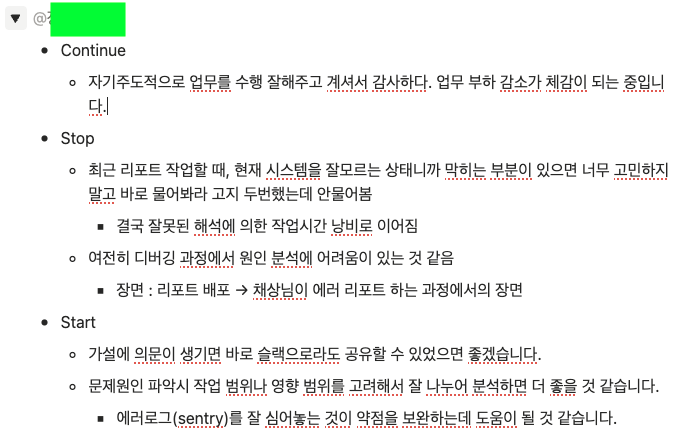
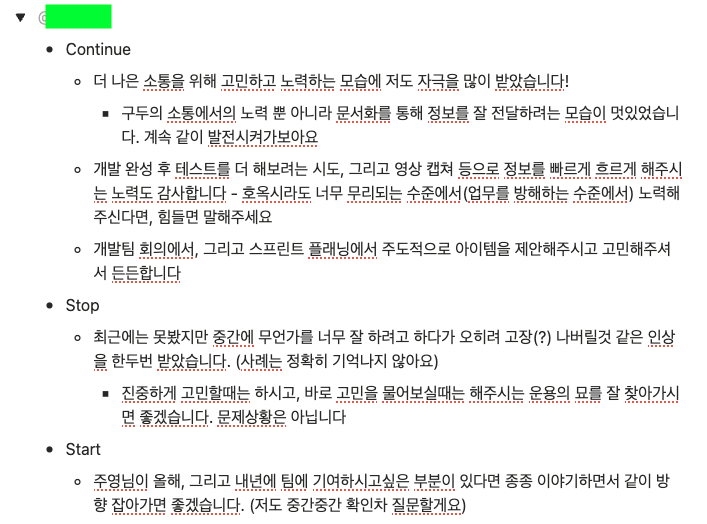
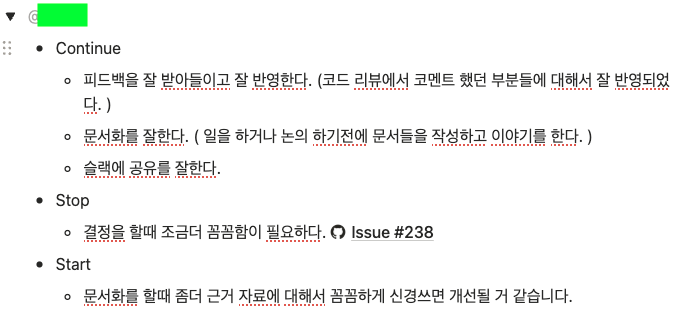
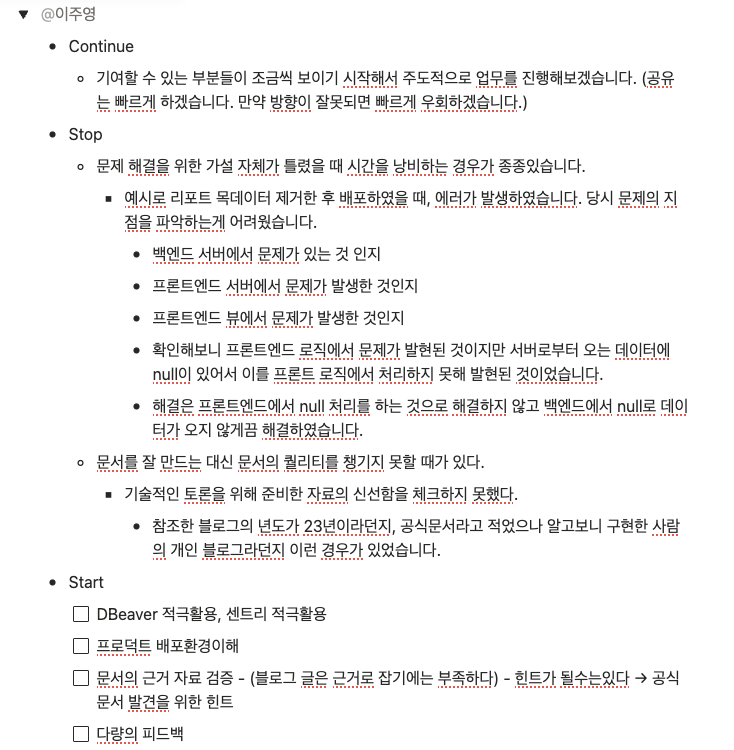
Here's the picture of myself that emerged after going through all the feedback.
Strengths worth building on
- Documentation-driven communication: actively using written docs to capture and share context and history
- Proactive QA and ownership: taking responsibility for assigned work and driving QA independently
- Receptive yet self-directed attitude: receiving feedback positively and actively seeking out work on my own
Areas to improve to become the kind of teammate people want to work with
- Debugging skills: I need to get faster at pinpointing where a bug lives when something goes wrong
- Technical research: when evaluating tech stacks or doing research, I need to gather stronger evidence and communicate findings more clearly
- Done over perfect: I tend to over-aim for perfection — I need to practice a "ship first, then iterate" cycle instead
My plan is to keep sharpening the strengths and, for the gaps, figure out the root causes and work on them intensively over the next two months.
A Technical Question: "Do We Actually Need to Move to Vercel Right Now?"
One of the bigger technical debates in October centered on adopting Next.js SSR for OpenDoctor's web SEO and figuring out the right deployment environment.
There was a view inside the team that "migrating to Vercel is a must for SEO optimization," but when I went back through the AWS Amplify documentation, I found myself questioning that premise. My thinking was: Amplify supports most of Next.js's core features — if Vercel offers something Amplify doesn't, is the absence of that thing actually a critical blocker for SEO optimization, which is our current goal?
So I looked up what each vendor supports and what it costs, then shared a summary with the team.
What Amplify does and doesn't support
Amplify supports most of Next.js's core features.
- Supported: SSR, SSG, time-based ISR, image optimization.
- Not supported:
- On-demand ISR: event-driven instant revalidation isn't available; only time-based revalidation works.
- Next.js Streaming: the streaming pattern that renders a UI skeleton first isn't supported, which could put us at a disadvantage compared to Vercel for LCP under Core Web Vitals.
- Middleware performance: the feature works, but it runs on AWS Lambda@Edge, which carries a real cold-start risk compared to Vercel's Edge performance.
The cost and risk of migrating to Vercel
Jumping to Vercel purely based on feature parity has a real cost.
- Vendor lock-in: Vercel supports every Next.js feature, but that's because Next.js is tightly coupled to Vercel's infrastructure. For a team with a bit of a contrarian streak… that's something to weigh.
- Increased operational cost and complexity: spreading infrastructure across more vendors adds management overhead and cost.
Conclusion: build Next.js SSR on Amplify first and optimize from there
After reviewing whether Amplify's limitations would meaningfully hurt our Core Web Vitals scores, or whether on-demand ISR's real-time updates are actually essential to our business right now — the answer was "not yet."
So my proposal was to first maximize SEO within Amplify — things like auditing image optimization and minimizing unnecessary dynamic rendering — and revisit a Vercel migration only if Core Web Vitals scores fall short of our targets or content freshness becomes critical.
There was also a lot of feedback that writing monorepo build scripts is painful on Amplify, but since OpenDoctor isn't a monorepo, that was another reason to just push ahead with what Amplify can do.
I figured we'd learn what we needed to by going through it… Future us, you've got this.
Starting to Build the OPN Design System
About three months in, I started seeing longer-horizon work I could contribute to — beyond just the immediate feature backlog. It was sparked by noticing that Seongwook, our PO and designer, was maintaining a separate OPN Design System file in Figma.
But with so much already on the plate, a design system — important but not urgent — felt like a hard project to just dive into.
So instead of jumping in with a simple "I'll do it!", I decided to first lay the groundwork to make this project realistically launchable. Before bringing it up formally in a sprint meeting, I did the following prep work:
- Design system research: analyzed examples from domestic and international design systems (Toss, LINE, etc.)
- OPN design system analysis: reviewed the Figma file the designer had been building
- Design system blueprint: estimated the development effort required, component by component
- Dev environment setup: initialized Storybook with a React base and configured the environment
With that groundwork in place, I put "Design System Build" on the agenda for the sprint meeting.
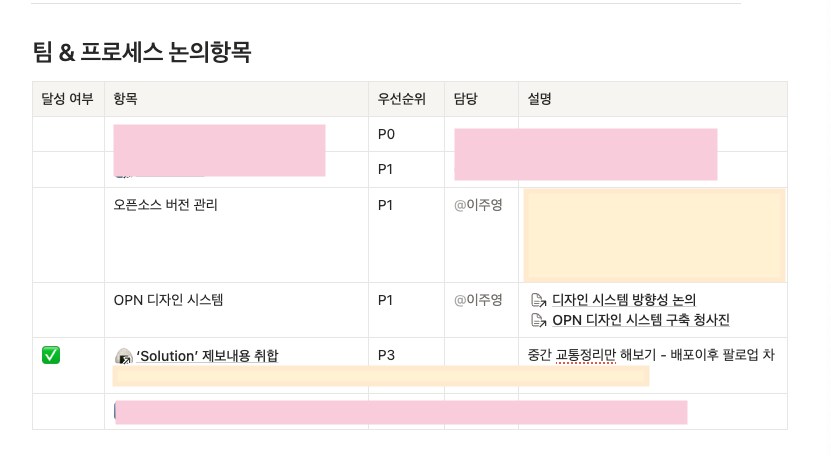
I know this project probably isn't the highest priority right now. So I talked it through with the designer and together we proposed an "intentional process" — one that wouldn't burden the existing sprint workload but would let us make steady, consistent progress.
Our lightweight process (start small, make it real)
- Regular design system component QA meetings: every Thursday at 3 PM, one hour for design system QA and sync
- Minimum sprint target: implement at least two components per sprint, then QA them together in Storybook
The plan is to run small cycles and incrementally complete the system. I'll check in on how it's going in next month's retrospective.
Late October 2025 — the start is small, but I think I'll look back on this with a smile next year. We started. That counts.
If you're a frontend developer who's been through building a design system before, please reach out in the comments or on LinkedIn… I could use the help.
Closing Thoughts
October was a month filled with small wins and warm feedback from teammates. Looking back at who I was three months ago versus who I am now, I felt deep gratitude again for the people who fueled this growth.
-
November action points
-
Complete and share a Next.js POC (Proof of Concept) for the new OpenDoctor
-
Write a Naver Maps API guide for OpenDoctor
- Code snippets for 3–5 core features (e.g., placing markers, calculating distance).
- "Key problems and solutions" we've hit (or will hit) — e.g., coordinate system errors, marker loading optimization.
- Initial setup instructions and auth key management for new team members.
-
Learn code editor debugging tools and apply them in real work